Header

Header
Showing posts with label Minifigs. Show all posts

Tuesday, 18 November 2025

Yet Another Unit of Peltasts


Mercenary Peltasts with Thureos

I thought I'd better get round to painting up a unit of these chaps - it's the Minifigs PB10 Mercenary Peltast with Thureos from the 1972/73 catalogue range. It's a very generic type of Hellenistic warrior and I'm sure it will fit in with a variety of armies - including my Persians! 

He's a fairly simple model in the Minifigs style and I've gone for a plain paint job with an off-white tunic. This is my 'go to' colour for peltasts and the like - a base of white mixed with British Uniform Khaki (Vallejo), washed over with Army Painter Soft Tone to give the ground colour, then built back up with the original colour plus white. 

The bronze helmets are my standard interpreation of bronze. Base coat with flesh as the same time as painting the face/head, then paint gold, wash with the AP Soft Tone, and work back up with gold and gold plus silver. I generally prefer the Vallejo metallics, if only because I'm familiar with them. 


Here's a few of them on the march - hopefully to victory although with these chaps being mercenary types you can never be too sure. 

The basing is the old Wargames Research Group Ancients standard 20mm frontage for what were then 'light medium infantry'. Geneally speaking, I've stuck to this standard for my 'retro' armies. The bases are mounting card and the green is mixed up to match. 

I do like the pose for this figure. It's purposeful without being fussy and the front view shows the shields nicely. This batch of figures hail from the earlier 'thick spear' era, which does at least make them sturdy! 

The shields are a mixed grey-blue. I tend to go for these de-saturated tones for shields as it makes them nice and bright but not too strongly coloured. I start of by mixing up a light grey and then just add tiny amount of a strong blue until the paint takes on a bluish tint. Paint always dries at least a shade darker, so I always paint up a single example as a tester. Because it's a mixed colour, I always paint the shields at the end, and mix enough to do the whole batch, it being impossible to get an exact match for the unit otherwise. 


And here he is marching off to do whatever he has to do. Good luck little fella. 

The unit has since received a couple of coats of nice shiny varnish. The shields are left plain for now, but might get a transfer if I can find something that suits. 


Monday, 25 August 2025

Two Battles - Part One


My re-booted 1970s Carthaginians and Persians have seen tabletop action for the first time this year, and not  just once but twice so far! I thought I'd take the opportunity to share the in-game pictures and offer a few observations on how things worked out.

The two armies are not exact historical contemporaries, of course, but they are close in terms of an 'ancient' wargame. They would certainly have been matched against each other when these figures were first marketted in the early 1970s. Anyone old enough will know that anything 1000BC to 1000AD was considered fair game back then. No-one blinked an eye to see Assyrians taking on Byzantines, or Vikings giving Classical Greeks a sound beating. In my case, the Carthaginians may be assumed to represent an army of the Second Punic War (218-204 BC) whilst the Persians are contemporary opponents of Alexander the Great (334-331 BC). 

The Persian army - how can Darius possibly lose! 


The Carthaginians - what no elephants! Hannibal is disappointed.

For our first outing I got together with Jervis Johnson. Nostaligic memories of fighting games using the old Wargames Research Group (WRG) rules swayed us to attempt a game using a version  contemporary with the actual models. And here are the rules we settled upon - the Wargamers Research Group Ancient rules 1000 BC to 1000AD, 3rd edition but updated and clarified as per the 4th edition. WRG rules were frequently amended between editions. This was achieved by sending a self-addressed envelope and receiving an update sheet, which you either cut and pasted in place or you wrote in the changes by hand. Hence, the half-way house between editions, and this is how you usually find second-hand copies. It was the way. The rules, and various others, can be freely downloaded from the WRG website. http://www.wrg.me.uk/WRG.net/History/wrg.html


WRG 3rd edition with play sheet

I worked out the opposing armies to more-or-less equal points values with the help of the 5th edition army lists. The total for both armies came out at about 2000 points excluding generals. This is somewhat larger than an average game would have been as I recall. We tended to play to 1000 points or up to 1200 if I remember correctly. I'm sure we played some much bigger games on occasion though. Jervis and I roped in Alessio Cavatore to share in the joy, and I put together a typical 1970s tabletop, i.e largely barren of terrain with a big open centre. I also prepared unit stat lists for each army with room for writing orders and recording casualties. Oh - and maps for indicating deployment. How we did love paperwork in our youth! 

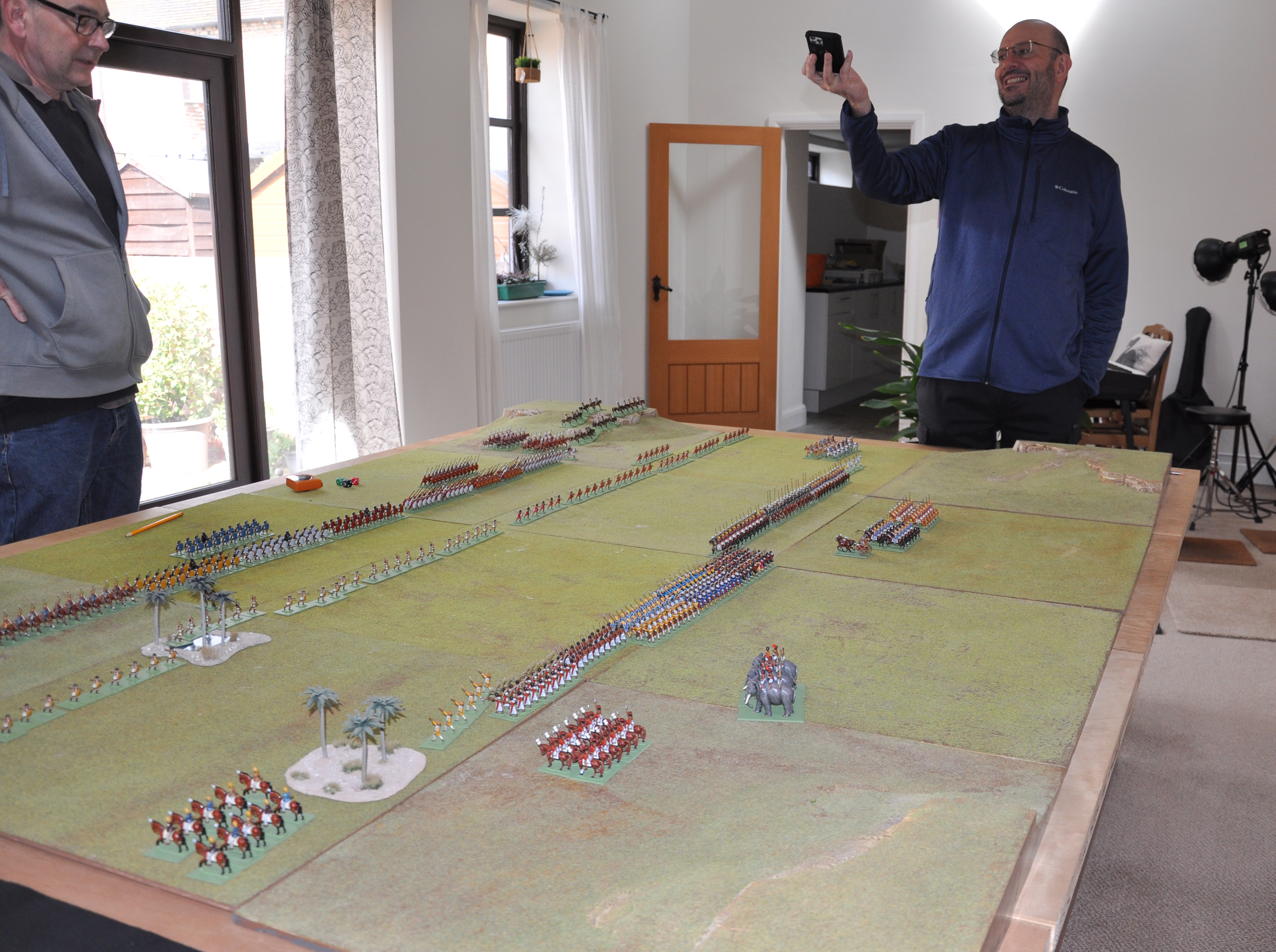
Given the size of my table (8ft wide 6ft deep) and the modest rate of knots achieved by a typical unit (they are over 50 years old so allowances must be made) we decided to deploy further into the table than we otherwise might. Splendiferous they look too! The first thing to notice is just how long the units are, with just a few skirmishers covering quite a large footprint, and even the fighting units having a relatively large frontage. 

We are a turn in at this point with both armies advancing.

Jervis, taking the Carthaginians, opted for a steady advance behind an extended skirmish line, with the cream of his fighting troops, namely his infantry spearmen, in the centre. The Persians, with myself and Alessio at the helm, made a geneal advance with a mass of infantry archers left of centre and cavalry right of centre. With our obvious advantage of firepower, we wanted to get within range as soon as possible. 

Persian cavalry left of the line.


Persians closing in on the Carthaginian lines. 


Both armies soon found themselves exchanging missiles, with the Persians having the advantage of longer range thanks to their massed 'medium' infantry archers. This gave us the opportunity to work out some shooting with the resultant 'reaction tests'. Modest casualties were inflicted upon the Carthaginian skirmishers sending some into retreat. 

Cavalry go into action against those pesky skirmishers.

The Persian cavalry advanced rapidly and managed to engage and largely upset the opposing skirmishers, routing several units and having a high old time of it. The Scythians were now busy entertaining some skirmishing infantry on the Persian right. 

Scythians and skirmishers exchange missiles before the cavalry drive off the opposing infantry. 

On the Persian left the Carthaginian skirmishers enjoyed brief brief success, at first driving back the Persian cavalry thanks to a poor reaction test. Things soon sorted themselves out, however, with the skirmishers once more driven off or routed. 

You're going the wrong way! Persian light cavalry forced into retreat by men with pointy sticks. 

The field looking twoards the Carthaginian right

With the Persian infantry left facing the Carthaginian skirmish line, and the main Carthaginian lines somewhat lagging behind, the fighting was all on the Persian right. At this point we hit a bit of a brick wall with the rules. Although, the armies had barely clashed, it had taken most of the day to get thus far, and we felt we had had quite enough for our first session. 

Now, you'd have thought with three professional games designers and getting on for 100 years of collective game design work behind us, we'd have coped easily enough with the rules. Boy, did we struggle. Even Jervis and I, who had played these very rules as lads, and later versions as young men, couldn't always figure it out. We were minded to think that the 'game' we played years ago was to a large extent governed by convention and mutual understanding. The rulebook certainly provides very little comfort when it comes to explaining how to go about things. Overall, the game felt slow and fiddly, with endless factors giving an impression of calculation and profundity, but results  determined by dice throws in a fairly random manner. We had some very entertaining reaction test results, with three dice rolled being no respecters of averages, and even combats prone to luck in a manner that rather surprised us. 

Both Jervis and I remarked upon how the simultaneous moves to orders, and seemingly non-existent turn sequencing, made the whole thing feel like a slow-motion computer simulation, with everything happening at the same time. Given when the game was devised, in a pre-computer age, that is perhaps understandable. Back then, a detail driven simulation - a ground up approach if you like - would have had a lot of appeal in terms of appearing to be 'worked out' from first principles. And, it cannot be denied that the game did look like an actual battle. However, the result is a very slow affair compared to modern rule sets, with complication at every level of play, and interactions often triggering further actions and yet more complication. 

It was an interesting exercise, although not one either of us was especially keen to repeat anytime soon. I must admit, my overwhelming urge as I sat with the rulebook trying to relearn the rules before we played, was to re-write it! Unfortunately, I think there are some fundamentals that don't work terribly well, and which are mechanically very 'fragile'. The main issue is the order system with simultaneous actions. In successive editions of the rules, you can see the author (Phil Barker) struggling to re-define and formalise the whole order-writing process. The result is to pile on yet more regulation and complexity. Eventually, the affair would be abandoned in favour of the more structured DBA rules, which have enjoyed an even longer life than the original set remaining popular today.

The most serious casualty of the experience was poor Alessio, lacking both the cushioning effect of nostalgia and the certainty that the game had definately 'worked' in the past, he proved tragically susceptible to the ensuing horror. I won't say he began to shake and weep, but it was a close thing for sure. 

For our second battle I resorted to a ruleset with which we are a bit more familiar - Hail Caesar - and a two-a side game with Dr Simon Elliott and Alan and Michael Perry. Next time I'll explain how we got on in Two Battles - part two. 


Friday, 28 March 2025

Persians and Carthaginians - finishing touches


Hinchliffe Persian Chariot

Well, a game looms, and it looks like we're going to be dusting off the old WRG Ancients rules, which means I need to make sure we have a 'general' for each side. The Minifigs 'Darius' is a curious figure that looks nothing like the King depicted on the famous Alesander mosaic, but has been duely painted up and will serve. 

Darius
Here he is, waving a spear around for no good reason, and resplendent in armour and carrying a shield. Quite what he has on his head I don't know. 

I sense that our Persian general really aught to be mounted in a chariot: that being the fashion of the time. Sadly, I've never been able to get hold of an 'S range' Persian chariot for him to ride in. 

For reasons that escape me, all of my original 70s armies that might otherwise feature Minifigs chariots or elephants have either Hinchliffe or Garrison versions. 

I dug out a pristine unmade Hincliffe Persion chariot and painted it up to serve as a general should the need arise. The Persian army already includes a unit of Garrison infantry, so it's a slightly heterogenous affair. 


While we're talking chariots, these venerable charioteers belong to my original Seleucid army. The two on the left are Garrison, the rest Hinchliffe. 

These are the untouched Humbrol paint jobs from forty years ago. 

Would you believe it? The Hinchliffe chariot (EG03) is still available, along with the rest of the Ancient range, from Lancashire Games


Meanwhile, having forgotten that I'd already painted up a Hannibal to lead the Carthaginians, I painted up another one. Still, always nice to have a choice... of Hannibals. 


I also managed to add a cavalry unit to my Gallic contingent. Surprisingly hard work as it turned out. The riders had a bit of 'slippage' and hence vicious moldlines, as well as some tearing and fill-in around the cloaks, but nothing that couldn't be dealt with. 

The horse though! Having worked my way through the 'good' stock of this particular horse, I was left with a pretty rough batch. Lots of fill-in between the front legs and around the tail. A lot of time-consuming cleaning up and recarving to do, but they turned out alright in the end. 

After which I discover what a terrible fit the riders are to the horses! This is a version of the horse sold at the time - there was an earlier version too. Liberal application of greenstuff sorted that out. 


I was pleased to get enough figures for a unit of these chaps, as it's not an especially easy one to find on the second-hand market. 


Sunday, 16 February 2025

Indians and Scythians

Minifigs PBC7 Dahae Horse Archers 

Some recent additions to my Minifigs Persian army include an Indian contingent and some Scythian cavalry. All the figures are from the Miniature Figurines 1972/73 catalogue. Most are from the, then brand new, 'PB' range 'The Macedonian and Punic Wars'. A few are taken from the older 'S' Range Ancients, which were in the process of being phased out at the time. All are what was commonly called '25mm' figures. They are considerably smaller than modern wargames figures as well as somewhat slighter.

I've painted up twelve of the PBC7 Dahae Horse Archers (Scythians to thee and me). Half are on these light coloured horses and half on greys. They can either be fielded as two distinct units or mixed to make a larger formation. 

The horses are the PBH65, which is the generic cavalry horse of 'other nations'. It's quite an attractive beast, although prone to filling in between the legs and reins. Quite a bit of carving required to remove chunks of metal and reshaping, Like all the PBH horses, this one has a saddle cloth, as does the rider, and the fit is a little off. Disguised with greenstuff to some extent. 

I suspect this figure was originally intended to fit either the older 'Ancient S Range' cavalry horses or the generic 'Light Cavalry Horses'. Both are slightly smaller and - more importantly - not burdened with saddlecloths. Despite this, the same rather small rider soldiered on with the even larger later-style horses introduced around 1975. Truly massive beasts in comparision!

The figure itself is in that typical Minifigs horse archer pose, shooting off to the side. It does look rather odd when the figures are lined up in a straight line. They do look good in a looser formation though.


As always, I've based these guys on plain green rectangles cut to the sizes stipulated by the contemporary WRG Ancients rules: 30mm frontage by 40mm depth. 

I've tried to give them a varied paint job whilst keeping an overall 'look'. So, all the horse furniture is the same colour throughout, as are the quiver, weapons and so on. 


I've also tried to keep the colours 'bright' without being 'too bright', as it were, and it seems to have worked reasonably well. 

Once again as always, all these chaps have been given a coat of gloss varnish, with a second coat over vulnerable spots likely to be handled. 


Minifigs Indian Elephants and PBC29 Indian Cavalryman 

A unit of cavalry and three elephants have joined the Indian contingent. Together with a couple of units of infantry, they will form part of one wing of my Persian army. Purists may well point out that Darius' Indian contingent fought in a single battle (Gaugamela). I, however, shall take liberties. Frankly, I couldn't resist the elephants. They are so cute. 

I'm not entirely sure whether the elephant and its crew were part of the 'S Range' rather than newly minted to go with the PB range. I suspect the former. The 72/73 catalogue shows the model with a quiver of javelins, which I have not got, and these three crewmen.
Minifigs elephants were never the most exciting of models. I do have a herd of Hinchliffe elephants, which are far larger and more dramatic. I saw these critters on ebay and bought them together with a batch of chariots. 

These models have been repainted using the original paint as an undercoat. The saves stripping the pieces but you do lose a little of the detail. Not that there was much to start with. 


Minifigs Inidan Elephants


The Indian cavalry figure is a typical Minifigs affair. It's a neat little figure taken from the Armies of the Macedonian and Punic Wars by Phil Barker. 
The horse is the Minifigs PBC Indian cavalry horse. It has this rather splendid and distinctive plume. It also has a rather less distinctive chamfron or something going on, which I've interpreted as metal. Who knows!
All the Indians stick to the same colour scheme based on red and white with some bronze detailing. 

I've based these as close-fighting cavalry - technically medium cavalry in terms of the old WRG rules. Sadly, there is but the single figure in the range and no specific light or heavy cavalry variants. The same rider mounted onto a smaller 'S Range' horse would make a passable light cavalryman.


Minifigs Indian Cavalry 


Sunday, 5 January 2025

A Few Gauls


Minifigs PB57 South Gaulish Javelinman 

A modest contingent of Gauls has been added to my old-style Minifigs Carthaginian army. Nothing to trouble the Romans as yet, but a decent start none-the-less.

The figures are from the original PB Armies of the Macedonian and Punic Wars range, harking back to the early 70s. These examples first appeared in the 1972 catalogue with 'S' sppended to the serial numbers indicated they were conceived of as part of the 'S range', i.e. 25mm 'specials'. In point of fact, they were the same size as the original 'S range' Ancients, and in some cases even the same models or updated versions. As time went on the new releases would creep up a bit in size, until the original line was replaced by bigger and chunkier versions in the late 70s.

The South Gaulish Javelinman is a simple figure in a standard pose for javelin-armed models. As I've covered on many occasions, there was an early release with very thick spear and javelins (telegraph poles as they have been dubbed) and a later release with spears and javelins that were much thinner but very fragile. These come from the later batch, and - true to form - the javelins were either partially or entirely missing. All have received new weapons made form brass rod, which should last them out.  


Gallic Warband in determined mode. PB57 with PB56 and PB153 in attendance. 

The skirmishes join my Gallic warband of PB56 South Gaulish Swordsman. I've been on the look-out for these for quite a while. They don't seem to come up very often on the second-hand market, and I suspect were not a great 'troop choice' when these figures were new. I managed to get enough to field a modest unit of 16 models. They came in two separate batches, one of which has been quite vigorously animated by a previous owner. Hence, some of the chaps of waving their weapons about in an irregular fashion. Rather than trying to neaten everything up, I've just gone with the slightly irregular appearance, and it doesn't look too bad overall. 


Rather than attempt the usual highly decorated shields, not to mention stripy rugby shirts and pyjama bottoms beloved of gamers half a century ago, I've stuck to my usual plain colour palette for these chaps and given them solid red shields. As ever. I've stuck to old-fashioned WRG base sizes and mounted the models without base decor to emphasise a clean 'toy soldier' aesthetic. I was tempted into using mdf bases for the skirmishers, and the result is a little thicker than I ideally like, but does save messing around with card. 

That standard bearer lurking in the background is from the Armies and Enemies of Imperial Rome range, PB153 Gallic Chieftain with Standard. He arrived with a broken standard, so I've replaced the pole with brass rod and re-affixed the boar standard, which led naturally enough into painting him up. 

These were definately not the best or cleanest of castings, with quite a bit of clag to carve out around the sword arm and behind the shield. Overall - rather hard work for such a modest result - but made up for by the rather nice hairstyles, which rather put in mind of 'Revolver' period Beatles. Tomorrow Never Knows! 

Monday, 30 September 2024

Minifigs Spaceships

Last year I put up a few pics of my old Skytrex spaceships - or rather what was left of these old cosmic warriors. You can check those out by following the 'spaceships' label if you wish. At the time I was messing about with a set of spaceship rules, which led me to dig out my rather eclectic fleets of models made by a variety of manufacturers over the years. That game is actually in production at the moment and will be released by the end of 2024 if all goes to plan, and to help out I've been photographing some of the newer models, as well as a few old classics. Whilst I was at it I thought I'd take a few pics of this very early Minifigs range. Many of my generation will remember these, and believe it or not they are still available from Miniature Figurines at Caliver Books, although for some reason the names of all the ships differ from the originals. As such, these are hardly rare, but they are 'of their time' and I remember them fondly. 


Sp.1 Earth Federation Depot/Battleship
This chunky fella is the Earth Federation Depot/Battleship, the largest and most expensive model in the range at all of 15p - about twice the price of a standard foot figure at the time. 

For scale referrence - the base I've used for these photos is 40mm diameter.


Sp. 2 Earth Federation Cruiser
The Cruiser version of the Earth Federation fleet was a more modest 10p. All the Earth Federation ships follow the same aesthetic with broad wing-like rear decks. 

As with all the other models in this post, I've angled these over to show the broad shape. They are all quite two dimensional and cast as a single piece. 


Sp. 3 Earth Federation Destroyer
The smallest of the Earth Federation Vessels is the Destroyer at a modest 8p.

This is a home made stand, which I've used to pose the ships. They all sit quite well on the tabeltop without a stand, but Minifigs sold a separate 'flight stand' for another 8p. The Minifigs flight stand appears to be made out of a mould stud! If I ever had any (which I'm sure I did) they got melted down and contributed to my early experiments in home casting. 


Sp. 6 Terresti Depot/Battleship
I collected the Terresti fleet - and also the Terresti 25mm SF figures. My friend and gaming nemesis Richard Halliwell collected the Earth Federation ranges and a third friend the Cehan. Between us we managed to amass three fairly substantial fleets. Writing our own rules, coming up with a campaign system, and inventing backstories for our games was all part of the appeal. All good experience for what would later turn into a job! 


Sp. 5 Terresti Cruiser
The Terresti ships all have a 'golden age' SF vibe - like something off the cover of Amazing Stories of the 40s and 50s. Of course spaceships need wings! 

The Miniature Figurines Catalogue for 1975 has this model and the previous one at 10p each despite the size difference.


Sp. 7 Terresti Destroyer
The Terresti Destroyer is but a wee version of the Cruiser and a mere 5p into the bargain. 


Sp. 8 Cehan Depot/Battleship
Cehan Depot/Battleship - I think! It's a bit hard to tell which of the two Cehan capital ships is which. Both are more or less the same size and both go for 10p

The Cehan models manage to fill quite a bit of space with not much metal - which must have come as a relief to the accountant at Minifigs after the extremely weighty Earth Federation range.

You have to admire the way Minifigs managed to cover three entire factions with but three ships apiece, with the depot and battleships conflated into a single model. In those days, if you wanted variety you had to get the hacksaw and araldite out. 


Sp. 9 Cehan Cruiser
The other Cehan ship - which I'm assuming is the Cruiser. If anyone knows better please shout out! 

The Cehan design are a little bit more outre and must have been a challenge to cast. I rather like this one even if it is rather hard to tell which direction it's facing in. 


Sp. 10 Cehan Destroyer
This is my favourite model in the whole range - the Cehan Destoyer. Not a great paint job on this one, but I'm sure you get the idea. Quite a small model and it could have been yours for all of 5p (and can still can be had even if the price has risen to £1.55 at the time of posting). 


Sp. 4 Vertos Cruiser
Minifigs only made one model for the Vertos line: the Vertos Cruiser. It's a distinctive shape and looks like someone raided their meccano box for the body of the thing. 

It's a pity we never had the battleship or destroyer versions of this design as I'm sure they would have proven popular. Alas, it was not to be, and soon other manufacturers were churning out rivals that would capture our imaginations. 

Still - I don't think we ever had quite so much fun as we did with these simple fleets, swooping over the dining room carpet, laser beams flashing and missiles zipping across space to wreak destruction upon our foes. 


From the 75 Catalogue . 
This is the illustated page form the 75 catalogue which shows some of the spaceships as well as the S.F range of figures. 

Looks like I was right about the Cehan Depot/Battleship - they have it down as number 8.

I've scanned and uploaded various early Minfigs catalogues and updates in the Pages section (to the right in web view) under 'Catalogues'. 


From the 75 Catalogue
This is the catalogue page listing the range and prices, along with the contemporary Science Fiction and Mythical Earth figure ranges.